Almarai: From a Desert Dream to the Food Industry Giant of the Middle East
Zurich: Djed – Ashraf Gaber
In 1977, when Saudi Arabia’s dairy industry was still limited and heavily dependent on imports, a bold idea was born, an idea that would transform the face of food across the region. That idea was Almarai, founded by Prince Sultan bin Mohammed bin Saud Al Kabeer. Today, Almarai stands as the largest integrated food and beverage company in the Middle East, a symbol of how Arab vision and determination can turn the seemingly impossible into reality.
Beginnings: Confronting Climate, Building Trust
Almarai began with modest farms in Riyadh, facing the daunting challenge of raising dairy cattle in a harsh desert climate. Yet the vision was clear: invest in agricultural technology, bring in global expertise, and build a fully integrated production chain from farm to consumer. This model, known as vertical integration, gave Almarai exceptional control over quality and costs, setting it apart from competitors from the very beginning.
Growth and Transformation
Throughout the 1980s and 1990s, Almarai expanded rapidly, becoming the first company in the region to apply vertical integration on a large scale. In 2005, it went public on the Saudi Stock Exchange, quickly becoming one of the most attractive and trusted listed companies.
Since then, Almarai has diversified beyond dairy into juices, bakery, poultry, and bottled water, strengthening its portfolio through strategic acquisitions such as Beyti in Egypt and Al-Fafa in Jordan. These moves positioned Almarai not only as a Saudi champion but as a regional powerhouse.
Factories and Human Capital
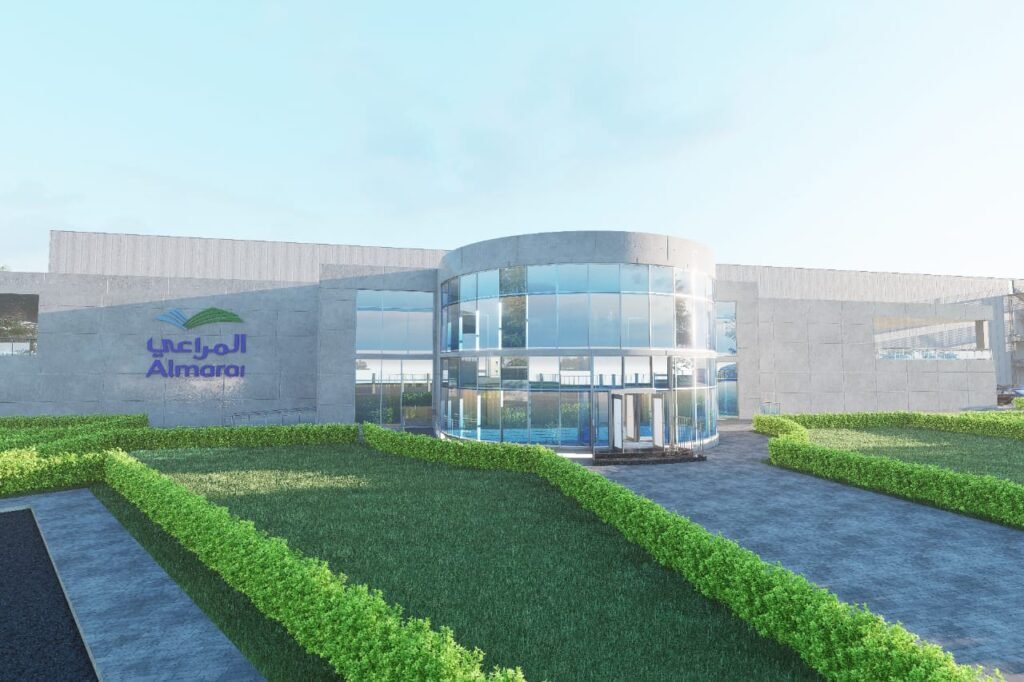
Today, Almarai operates a sophisticated network of factories across Saudi Arabia, Egypt, and Jordan, equipped with state-of-the-art processing and packaging technologies. These facilities produce not only dairy and juices but also baked goods, poultry, and bottled water, ensuring that Almarai’s products reach millions of households daily.
Behind this infrastructure stands a workforce of more than 45,000 employees from over 60 nationalities. Almarai is more than a workplace; it is a school of excellence, investing heavily in training and skill development. This commitment ensures that quality and innovation remain at the heart of everything the company delivers.
Numbers and Achievements
- Market capitalization: SAR 48.4 billion (~USD 12.9 billion) [November 2025].
- Revenue, H1 2025: SAR 11.05 billion (~USD 2.95 billion), up 4.1% year-on-year.
- Net profit, Q3 2025: SAR 613 million (~USD 163 million), up 7.5%.
- Daily reach: Almarai products serve more than 42 million consumers every day across Saudi Arabia, the Gulf, Egypt, Jordan, and North Africa.
These figures underscore Almarai’s scale and resilience, making it one of the largest dairy companies in the world by volume and a benchmark for integrated food production globally.
Philosophy of Success
Almarai’s success rests on three guiding pillars:
- Quality First: The company’s enduring motto is that consumers deserve the best. This has driven continuous investment in cutting-edge agricultural and food technologies.
- Relentless Innovation: From introducing new product lines tailored to local tastes to pioneering modern packaging solutions, Almarai has consistently led the way in innovation.
- Social Responsibility: Almarai believes success must reflect positively on society. It has supported education, healthcare, and environmental sustainability programs across the region.
Leadership and Future Ambitions
Since August 2025, Almarai has been led by a new Board of Directors chaired by Prince Naif bin Sultan bin Mohammed bin Saud Al Kabeer, with Mr. Suleiman bin Abdulqader Al-Muhaidib serving as Vice Chairman. This leadership reflects a balance of heritage and forward-looking vision, working to strengthen Almarai’s global standing.
At the executive level, Abdullah bin Nasser Al-Bader serves as Chief Executive Officer, having risen through the company since 2000 to become its top leader in 2021. Alongside him is a diverse management team blending Saudi expertise with international experience, including:
- Danko Maras (Chief Financial Officer).
- Andrew Mackie (EVP, Farming).
- Ayman Al-Qeer (Chief Human Resources Officer).
- Michael McDonald (EVP, Protein).
- Nishit Mathur (EVP, Bakery).
- Shadi Al-Qatati (EVP, International Markets).
- Chris Langhorn (Chief Strategy & Planning Officer).
This leadership team is driving Almarai’s bold five-year strategic plan announced in March 2024, with investments of SAR 18 billion (~USD 4.8 billion) through 2028, including:
- SAR 7 billion (~USD 1.87 billion) to expand poultry operations.
- SAR 5 billion (~USD 1.34 billion) to strengthen dairy, juice, and bakery lines.
- SAR 1 billion (~USD 267 million) to enter new food sectors.
- SAR 4 billion (~USD 1.07 billion) to enhance supply chain and sales capabilities.
- SAR 1 billion (~USD 267 million) to support technology and innovation.
This plan reflects Almarai’s ambition not only to remain a regional leader but to become a global player in the food industry, competing with multinational giants such as Nestlé and Danone, while staying rooted in Arab values.
Impact Beyond Food
Almarai today is not just a company that produces food, it is an institution that shapes lives. Its products have become part of the daily rhythm of families, from fresh milk to juices and baked goods. Yet its true impact lies beyond consumption: Almarai has become a symbol of how Arab companies can compete globally, build sustainable economic models, and inspire confidence in challenging environments.
National and Regional Legacy
When the name Almarai is mentioned, it is not only recognized as a brand but celebrated as a national and regional legacy. A story that began as a dream in the Riyadh desert has grown into a food industry giant studied in business schools as a model of success.
Almarai’s journey is a testament to the power of Arab ambition, to create companies of global stature and leave a legacy that transcends borders.